


- Spanish |
- English
The coal little Girl Audiodescription.
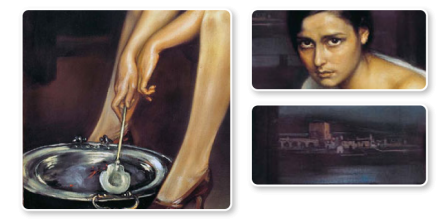
The art of Julio Romero de Torres reached its peak with this work from 1929-1930. On March 24th 1965 a fragment of "La Chiquita Piconera" (The Coal Little Girl) were taken to issue one series of stamps of Romero de Torres.
The scene takes place inside a humble room, where a young woman is seated in a bulrush chair. She is leaning toward a small copper brazier and holding in her hands a metal tool. She is wearing a brown skirt up to her knees, showing her legs. She is wearing silk stockings with orange suspenders. She is also wearing a light blouse that shows her bare left shoulder and part of her breasts. Her posture could be said to be provocative and laid-back. Her naïve oval face is a frame to outstanding dark eyes, a thin nose and a small mouth. Her dark hair is up on one side and creates a contrast with her golden shinny skin. A door opened allows the sight of the Paseo de la Ribera (Cordovan Avenue), the Roman Bridge, Calahorra under a dusk sky. His usual backgrounds of brights dusks get there darker. Premonition —may be— of the sparkling of his eyes.
"La Chiquita Piconera" depicts the model María Teresa López, and is the real pictorial testament of Julio Romero de Torres. This painting summarized all his art conception. It is a summary of his whole artistic lifetime. In this painting there is a message about what Romero de Torres understood about painting and what he wanted to express through his art. In a broad sense, this expressionist painting pass on us his artistic conception— more than the pleasure of contemplate a beauty and original portrait— as so as his "unacknowledged" life conception in a maturity portrait plenty of peace.
His technique was almost photographic in the treatment of the angles. The model does not look into the distance as in classical paintings; but in a direct and close way where there are all of the fundamental elements that define the artwork of Romero de Torres. His misty Córdoba, always distant and close, beauty as an ideal, reflected in women, the combination passion and frivolity, sweetness and disappointment, archaism and modernity, nostalgia and presence. Lastly, his leonardian way of painting in its entirety after the artist surpasses the archaic tendencies learned during his formation in the first years.

Press the Play buttons to access a speech version of the description or the audiodescription for visually impaired.
Click in Audiodescription to access to its text version.

Museum Julio romero de torres. Square Potro 1, 14002 Córdoba
2011 Ayto. de Córdoba. All rights reserved. Legal Advice