


- Spanish |
- English
Death of Saint Ines Audiodescription.
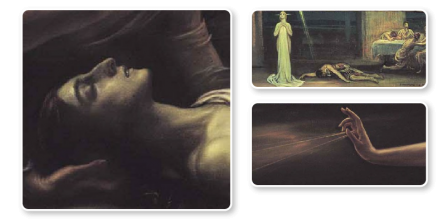
Romero de Torres used religious subjects in his works in a very personal way. The painter had a specially mystic vision and reflects with his works some of the classic biblical subjects. The leading figures of the paintings are usually depicted with sensuality.
La Muerte de Santa Inés (The Death of Saint Ines) was painted in 1918 and shown in the Exposition of Buenos Aires in 1922 and in the Spanish-American Exposition in Seville in 1930. Although the work had been commissioned by the Buenos Aires Metropolitan Cathedral, the artist kept it due to his mother's love for the piece.
The canvas was adapted to the baroque frame of a frontal altar, following the artist's custom of choosing golden baroque frames for his works. Some critics have defined this custom as “Byzantine”.
The inert body of Saint Ines appears on a flagstone covered by a shroud. Her expression shows her as if she were alive, dreaming, and not dead. In each extreme an angel is leaning over the woman, one of them holds her head delicately, with her right hand. He is dressed with light clothes, letting us see his right shoulder, and covering part of his body with a big blue shall. He asks for silence through a gesture and the other holds her feet, , [delicately, with his left hand, wearing a purple robe that also allows us to see his back and left shoulder. He is discharging with his right hand open a life-saving ray of Light on the saint’s body. Both angels seem to be leaning down, perfectly fitted in the picture’s composition.
On the top of the altar there are two scenes representing the life and martyrdom of Saint Ines. In the first scene, on the left, we can see the tempting offer of earthly wealth. We can see Santa Ines praying, wearing a long white dress, and showing her back to several figures. They are wearing light robes, in offering positions. In the second, on the right, we can see the pleasures of the flesh. Santa Ines manages to escape dressed in a bright long dress, facing the viewer. In the background, there are several drunk figures. The picture depicts debauchery. Saint Ines is temped with material wealth, in the second scene, with carnal pleasures which Saint Ines rejects. This work is the most important religious painting of Romero de Torres. Here the painter shows himself as an absolute believer, for whom death isn’t darkness but rather a transitional period to another life through a restful sleep. Romero de Torres was a religious painter who reached all his sublime inspiration and brought his work to the human boundaries with an admirable realism.

Press the Play buttons to access a speech version of the description or the audiodescription for visually impaired.
Click in Audiodescription to access to its text version.

Museum Julio romero de torres. Square Potro 1, 14002 Córdoba
2011 Ayto. de Córdoba. All rights reserved. Legal Advice